Introduction
Economic commentators often describe the modern economy using two concepts:
- the K-shaped economy
- the barbell economy
At first glance, they appear to describe different trends.
In reality, they are closely related.
Both frameworks explain why certain businesses and workers are pulling ahead while others face increasing pressure.
Understanding these shifts helps explain why enterprises and structured operators are becoming more resilient in today’s environment.
The K-Shaped Economy
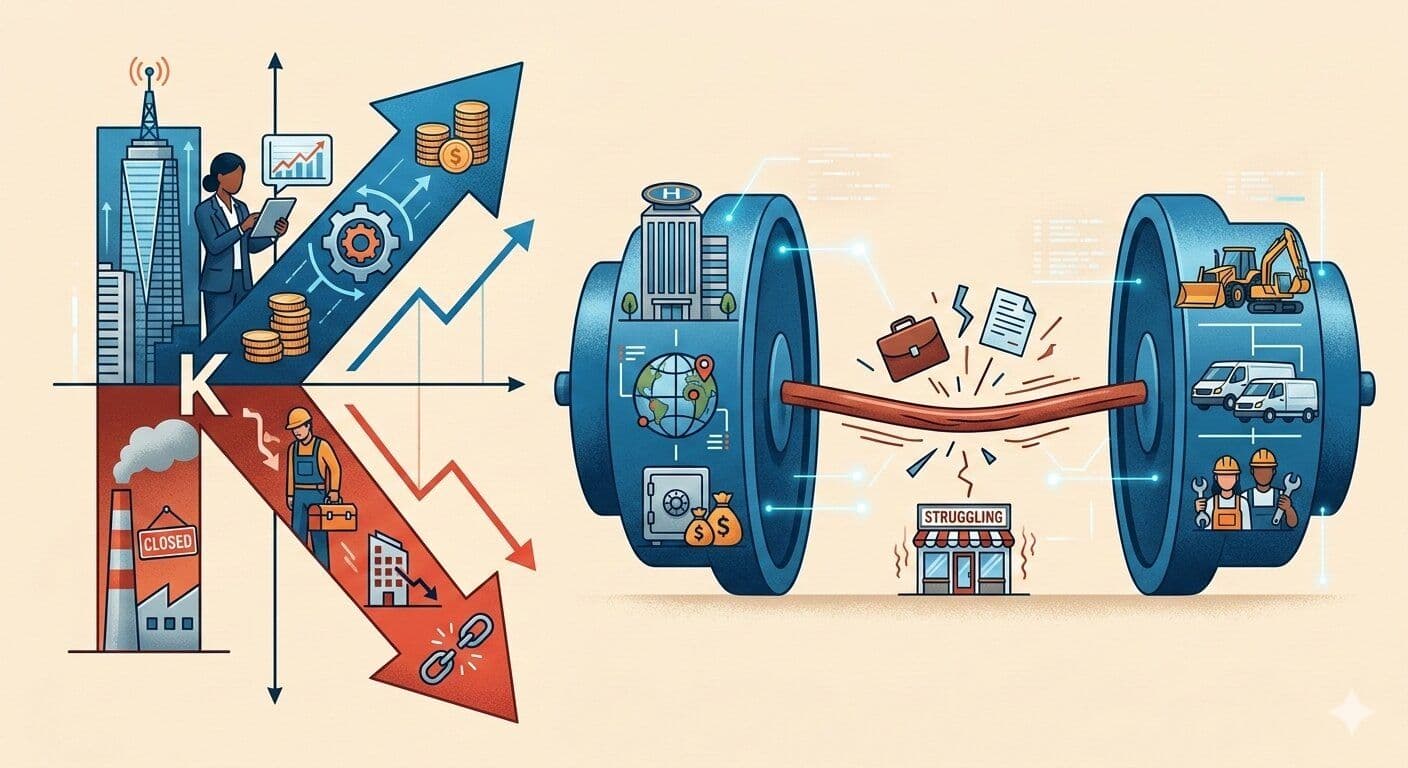
A K-shaped economy describes a recovery where different groups move in opposite directions.
One side of the economy improves rapidly, while another declines.
The result resembles the shape of the letter K:
- the upper branch rises
- the lower branch falls
Examples often include:
- large technology firms expanding rapidly
- asset-heavy businesses gaining value
- high-skill professionals benefiting from automation
Meanwhile other groups may experience:
- shrinking margins
- unstable employment
- increasing competition in commoditized services
The K-shape highlights economic divergence.
The Barbell Economy
The barbell economy describes a similar pattern, but focuses more on business structure.
In a barbell economy, strength concentrates at two ends:
🏢 Enterprises with massive scale and capital
🛠 Operators with structured, asset-backed businesses
Between these two poles lies a thinner middle layer.
Businesses in this middle often rely heavily on:
- abstract service models
- fragmented workflows
- unstable demand cycles
These models can struggle when markets become volatile or highly competitive.
How the Two Concepts Connect
The K-shaped economy explains the direction of economic divergence.
The barbell economy explains where stability tends to concentrate.
They reinforce each other.
In many industries:
- large enterprises dominate through capital and infrastructure
- structured operators thrive through assets and operational discipline
Meanwhile the middle layer — businesses without scale or structure — often faces the greatest pressure.
Why Operators Are Becoming More Important
Operators occupy the right side of the barbell because they control real-world capacity.
Examples include businesses with:
- rental fleets
- equipment or vehicles
- technician teams
- recurring service contracts
- structured booking systems
These businesses combine assets with operational systems.
Assets create supply.
Systems coordinate that supply.
Together they produce predictable workflows.
Systems Turn Capacity Into Structure
Assets alone do not create resilience.
Operators gain leverage when assets are combined with systems such as:
- booking and scheduling platforms
- dispatch coordination
- payment automation
- operational analytics
When availability becomes structured:
capacity becomes visible
workflows become repeatable
revenue becomes predictable
The business becomes easier to manage and scale.
Why This Matters for Platform Infrastructure
As operators adopt more structured systems, the software they use also evolves.
Rather than relying entirely on generic tools, many businesses are building infrastructure that supports their operational workflows.
Examples include:
- booking platforms for equipment fleets
- dispatch systems for service teams
- inventory scheduling for rental operators
- payment systems connected directly to operational capacity
Platforms such as Bookzia support this type of operator infrastructure by providing booking systems designed around real operational workflows.
Final Thoughts
The K-shaped economy describes the growing divergence between winners and losers in modern markets.
The barbell economy describes where durable business models tend to concentrate.
Enterprises succeed through capital and institutional scale.
Operators succeed through:
- asset control
- operational discipline
- structured systems
In an environment where complexity is increasing, businesses that combine real-world capacity with well-designed operational infrastructure are increasingly positioned to thrive.