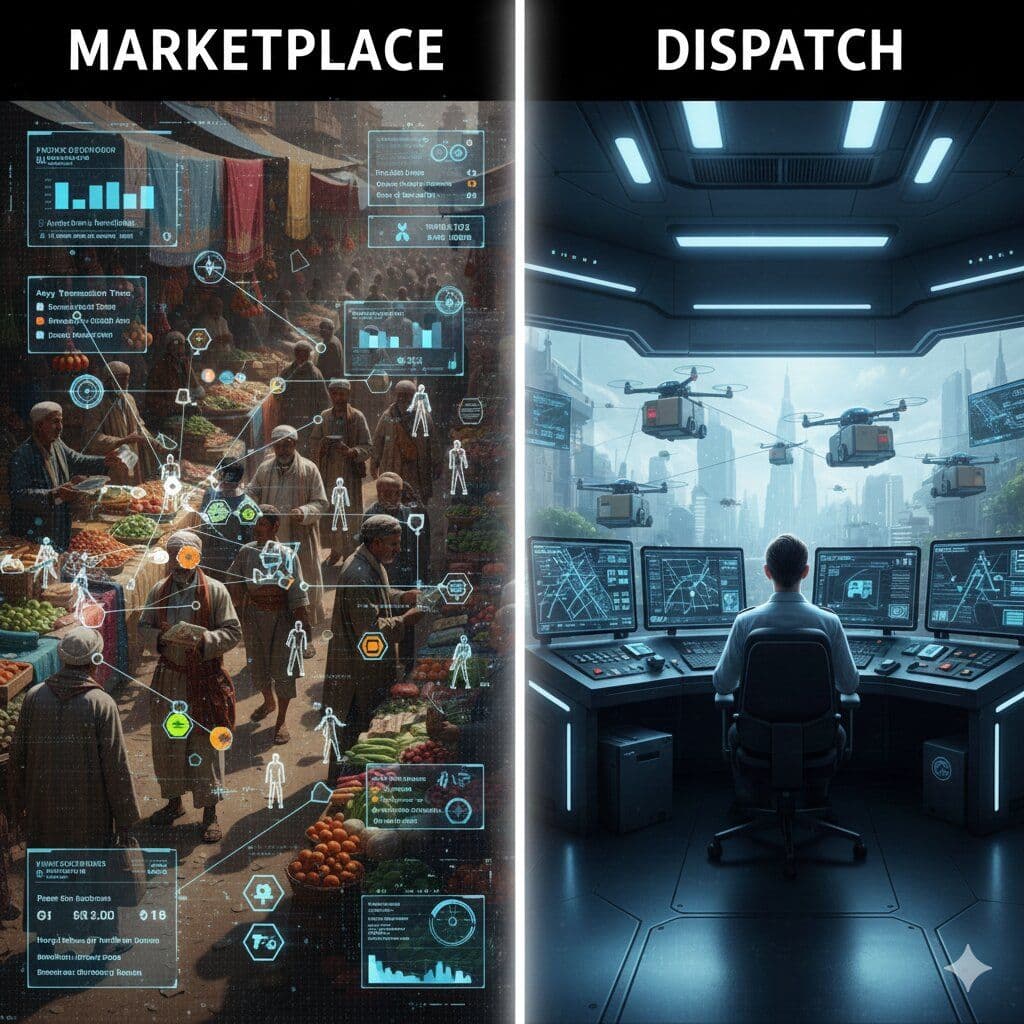
The choice between a marketplace and a dispatch platform is often misunderstood as a question of scalability.
In reality, both models scale when they align with supply dynamics and operational responsibility.
The real decision comes down to:
- Supply density
- Uniqueness of supply
- Responsibility for delivery
- Who is making the decision (operator vs founder)
🧭 Core Definitions
| Model | Description |
|---|---|
| Marketplace | Customers browse visible providers and book directly |
| Dispatch | The platform assigns jobs internally to providers |
Both models are proven. Problems arise when the wrong model is chosen for the context.
📊 Supply Density
Supply density refers to how many suitable providers are available within a given area and time window.
| Supply Density | Better Natural Fit |
|---|---|
| High (many interchangeable providers) | Dispatch |
| Low (few providers available at a time) | Marketplace |
- Dispatch works best when supply is abundant and flexible
- Marketplaces work best when supply is scarce or timing-sensitive
🧩 Uniqueness of Supply
Uniqueness of supply describes how different providers are from one another.
| Supply Characteristics | Better Natural Fit |
|---|---|
| Standardized, repeatable services | Dispatch |
| Differentiated skills, assets, or styles | Marketplace |
When providers differ meaningfully, visibility and choice become more valuable than speed.
🛡️ Responsibility for Delivery
| Model | Who Guarantees Delivery |
|---|---|
| Marketplace | The provider |
| Dispatch | The platform |
Marketplace responsibility
- Availability is public and provider-managed
- Customers book a specific provider
- Missed fulfillment is a provider-level issue
Dispatch responsibility
- Availability is implicit or internal
- Customers book the platform itself
- Missed fulfillment is a platform-level failure
Dispatch platforms trade higher control for higher responsibility.
🧠 Operator vs Founder Tendencies
This is where misalignment often occurs.
Operator-led businesses often choose dispatch
- They already manage teams or contractors
- They want reliability and control
- But sometimes their supply is too unique or too limited, making a marketplace the better fit
Founder-led businesses often choose marketplaces
- They want flexibility and faster validation
- They avoid operational responsibility early
- But sometimes their service is highly standardized, where dispatch would be more efficient
The mistake is not choosing marketplace or dispatch —
the mistake is choosing based on preference instead of supply reality.
🧱 Scalability Reality Check
| Question | Marketplace | Dispatch |
|---|---|---|
| Can it scale? | Yes | Yes |
| Scaling bottleneck | Supply liquidity | Operational execution |
| Primary risk | Thin or fragmented supply | Fulfillment guarantees |
| Scaling lever | Visibility & choice | Process & automation |
Neither model is inherently more scalable.
They simply scale different constraints.
🔄 Blending Both Models Over Time (Very Common)
As platforms grow, blending marketplace and dispatch mechanics is the norm, not the exception.
| Evolution Pattern | Description |
|---|---|
| Marketplace → Dispatch | Start with choice, add assignment as volume and reliability expectations increase |
| Dispatch → Marketplace | Start internal, expose supply later to expand capacity |
| Conditional Dispatch | Marketplace by default, dispatch for instant or overflow jobs |
| Operator-Controlled Choice | Customer chooses the service; platform assigns the provider |
This evolution usually happens when:
- Supply density improves
- Customer expectations shift toward reliability
- Operators gain better operational tooling
- The platform learns where guarantees truly matter
Mature platforms rarely remain “pure” marketplace or “pure” dispatch.
🧠 Practical Rule of Thumb
Both marketplaces and dispatch platforms scale.
What changes over time is where choice ends and responsibility begins.
🧠 Summary
- Marketplace and dispatch are both scalable models
- Operators often default to dispatch when a marketplace may fit better
- Founders often default to marketplaces when dispatch may be more efficient
- Supply density and uniqueness matter more than preference
- Dispatch shifts delivery responsibility to the platform
- Marketplaces shift delivery responsibility to providers
- Blending both models over time is common and often necessary
Choosing the right starting model—and allowing it to evolve—reduces operational risk and aligns expectations across the platform.